Connect with others who understand.

  •   Learn from expert-reviewed resources
  •   Real advice from people who’ve been there
  •   People who understand what you’re going through
Sign Up Log In
Powered By

Palmoplantar Pustulosis and Psoriasis: Pictures, Symptoms, and Treatment

Medically reviewed by Paul A. Regan, M.D., FAAD
Written by Joan Grossman
Updated on October 16, 2026

Key Takeaways

  • Palmoplantar pustulosis is a rare, chronic skin condition that causes recurring pustules on the palms of the hands and soles of the feet, and is often considered a form of psoriasis.
  • PPP can cause itching, pain, thick scaling, and cracked skin that makes everyday activities like walking or holding objects very difficult. Researchers are still learning about what causes PPP, but possible factors include sweat gland disorders, genetic changes, and certain triggers like smoking or infections.
  • If you think you might have palmoplantar pustulosis, reaching out to a dermatologist is a great first step, as they can help you find a treatment plan that works for your symptoms and overall health.
  • View all takeaways

If you’ve had breakouts of itchy, scaly, or painful pustules on the soles of your feet or the palms of your hands, you may have palmoplantar pustulosis (PPP).

Palmoplantar pustulosis is often considered a form of psoriasis. Up to 24 percent of people with PPP also have psoriasis on another part of the body. Other names for the condition include chronic palmoplantar pustular psoriasis and pustulosis palmoplantaris.

If you have palmoplantar pustulosis — or think you might — talk with your dermatologist. Although this condition can sometimes be challenging to manage, there are treatments that may help.

🗳️ How much do palmoplantar pustulosis symptoms affect your day-to-day life?
A lot
Some
A little
Not at all

Read on to learn more about palmoplantar pustulosis and how it may affect people with psoriasis, including people with psoriasis on the hands or feet.

What Is Palmoplantar Pustulosis?

Palmoplantar pustulosis is a rare, chronic skin condition that can come and go over time and causes recurring sterile pustules on the palms and soles. The pustules aren’t contagious or caused by germs. PPP can cause itching, pain, thick scaling, cracked skin, and trouble using the hands or feet.

Recognizing Palmoplantar Pustulosis Symptoms

Palmoplantar pustulosis is sometimes classified as a localized form of pustular psoriasis, although some health experts consider it a separate condition. It specifically affects the palms of the hands and soles of the feet, unlike generalized pustular psoriasis, which can show up anywhere on the body.

PPP symptoms that may develop on your palms and soles include:

  • Sterile pustules (germ-free, noncontagious, pus-filled pustules)
  • Thick plaques (patches of thick, discolored skin that may resemble plaque psoriasis)
  • Itching
  • Pain or a burning sensation
  • Scaly skin that may turn brown or yellow, depending on your skin tone
  • Fissuring (cracked skin)

Palmoplantar pustulosis can resemble other skin disorders, which may make it difficult to diagnose. These conditions include acrodermatitis continua of Hallopeau, a related skin disease, and the following skin disorders:

  • Contact dermatitis
  • Dyshidrotic eczema
  • Pityriasis rubra pilaris
  • Palmoplantar keratoderma

Pictures of Palmoplantar Pustulosis Symptoms

Palmoplantar pustulosis can significantly affect your quality of life. The painful cracks and lesions can make daily activities such as walking, standing, and using your hands difficult.

PPP symptoms may be worsened by weather changes, pressure or friction, manual labor, or household chores that involve detergents or other irritants.

Severe palmoplantar pustulosis on the palms with many yellow-white pustules, peeling skin, and cracked areas.
Palmoplantar pustulosis can cause severe pustules and peeling on the palms, making it hard to perform daily activities that require the use of your hands. (CC BY-NC-ND 4.0/DermNet)
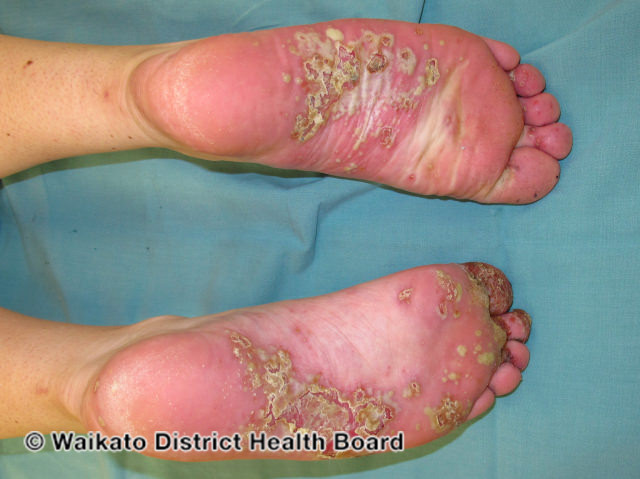
Palmoplantar pustulosis on the soles of the feet with thick scaling, inflamed skin, and clustered pustules.
When palmoplantar pustulosis develops on the soles of the feet, walking can become painful and difficult. (CC BY-NC-ND 4.0/DermNet)

Although palmoplantar pustulosis refers to a condition on the palms or soles, other areas of the body, particularly the nails, may also be affected.

Toenails affected by palmoplantar pustulosis, with thickening, discoloration, and surface changes.
Toenails and fingernails may also be affected by palmoplantar pustulosis. (CC BY-NC-ND 4.0/DermNet)

MyPsoriasisTeam Members on Palmoplantar Pustulosis

PPP flare-ups can greatly affect your life. MyPsoriasisTeam members living with palmoplantar pustulosis have shared their experiences and frustrations.

“I have palmoplantar pustulosis psoriasis — trying to learn everything I can. So far, trying diet changes, stress control, natural remedies, and moisturizer creams,” a member wrote. “I have one flare-up after another. The prospect of this spreading and getting worse isn’t comforting.”

Another member said, “I have palmoplantar psoriasis and am in a huge flare. I can barely hold a cup! It makes everything seem 100 times harder. I guess the only good thing is no dishes.”

One MyPsoriasisTeam member wrote, “I also have palmoplantar psoriasis, and mine has spread fairly rapidly. I have also noticed two small patches on my arm. My family doctor thought it was psoriasis coming in there also. The new ones on my arm don’t look like much yet, so I’m not sure what is going to happen.”

What Causes Palmoplantar Pustulosis?

Palmoplantar pustulosis is an autoinflammatory condition, but medical researchers don’t fully understand its cause.

Researchers have several theories about factors that may be linked to PPP, including:

  • Disorders in the eccrine sweat glands, which are prevalent in hands and feet
  • Genetic variants or mutations (changes)
  • Bacterial infections such as chronic sinusitis, chronic or acute tonsillitis, and dental infections
  • Contact allergic reaction to some metals

Sinusitis, tonsillitis, dental infections, and metal sensitivity are best understood as possible triggers or associated factors, not proven direct causes. Some dermatology research also describes drug-induced paradoxical PPP, or PPP in response to a drug, as a special form of the condition.

Tumor necrosis factor (TNF)-alpha inhibitors are biologic medications used to treat psoriasis and other inflammatory conditions. In rare cases, they may be linked to paradoxical PPP, meaning the medication may trigger a condition it might otherwise be expected to help.

Risk Factors

Women are more likely than men to develop palmoplantar pustulosis, according to the National Psoriasis Foundation. A family history of psoriasis is also found in some people with palmoplantar pustulosis.

Smoking or having smoked in the past is also a recognized risk factor for PPP. Smoking is associated with inflammation and vascular damage (affecting the blood vessels) in the skin.

What Comorbidities Are Linked to Palmoplantar Pustulosis?

People with palmoplantar pustulosis have a risk of developing some of the same comorbidities (coinciding conditions) that occur in people with psoriasis. These include heart disease, metabolic disorders, and psychiatric conditions.

Compared with people with psoriasis, people with PPP may have a higher risk of developing conditions such as type 1 or type 2 diabetes, allergic contact dermatitis, celiac disease, and inflammatory bowel disease.

People with palmoplantar pustulosis may be less likely than people with psoriasis to develop other comorbidities, such as:

  • Psoriatic arthritis
  • Metabolic dysfunction-associated steatotic liver disease (MASLD)
  • Certain skin cancers

Some comorbidities may be serious if left untreated, so be sure to discuss your risks with your doctor.

How Is Palmoplantar Pustulosis Treated?

Palmoplantar pustulosis can sometimes be challenging to manage, but several topical and systemic treatment options, as well as light therapy, may help control symptoms.

There are no U.S. Food and Drug Administration (FDA)-approved treatments specifically for PPP. Some treatments overlap with psoriasis treatments, but your dermatologist will recommend therapies based on your symptoms, overall health, and treatment history.

Always discuss a new treatment in detail so that you understand exactly how it should be used and are aware of any potential side effects.

Topical Treatments

Topical therapies that may be used first include corticosteroids, sometimes with occlusion — covering to increase effectiveness — and calcipotriene cream (Dovonex). Other over-the-counter (OTC) and prescription emollients, ointments, or creams with ingredients such as coal tar, salicylic acid, and urea may help some people.

Always discuss OTC products with your dermatologist before trying them, because some ingredients can make medications less effective. For instance, salicylic acid should not be used with calcipotriene. Topical steroids should be used only as directed to avoid unwanted side effects.

Oral Treatments

Systemic oral medications may include:

  • Acitretin, an oral retinoid derived from vitamin A
  • Methotrexate, a disease-modifying antirheumatic drug (DMARD)
  • Cyclosporine, an immunosuppressant
  • Apremilast (Otezla), a phosphodiesterase 4 inhibitor that has been studied for PPP

Acitretin must not be used during pregnancy, and pregnancy must be avoided during treatment and for three years after taking it.

Apremilast is not FDA-approved specifically for PPP. A recent review reported that apremilast showed better response rates than placebo in a clinical trial, but evidence is still limited.

Light Therapy

Newer treatments with laser therapy have been reported as promising. Standard light therapies — also known as phototherapy — for palmoplantar pustulosis include psoralen with ultraviolet A light (PUVA) and narrowband ultraviolet B.

“I have just completed PUVA treatment for my palmoplantar pustular psoriasis,” one MyPsoriasisTeam member reported. “I would say it’s 90 percent gone. I had 32 treatments over almost five months.”

Biologics

In severe cases in which palmoplantar pustulosis doesn’t respond to other treatment options, a specialist may recommend biologics. These drugs are administered by either subcutaneous (under the skin) injection or intravenous infusion. Their use for PPP is generally off-label in the United States.

If you also have palmoplantar psoriasis symptoms on your feet, your doctor may adjust your treatment plan based on where symptoms appear and how much they affect your daily activities.

Skin Care Tips

Along with sticking to your recommended treatment plan, focusing on skin care can help protect irritated skin. Avoid harsh soaps, bubble bath, or shower gel on affected areas.

Instead, use a fragrance-free emollient or moisturizing cleanser, especially if your skin is cracked. Moisturize affected areas regularly.

Identifying and avoiding triggers can also help protect skin from outbreaks of palmoplantar pustulosis.

MyPsoriasisTeam Members on Managing Palmoplantar Pustulosis Symptoms

MyPsoriasisTeam members have shared personal tips for skin care that have helped relieve their PPP symptoms. These are personal experiences, not proven PPP treatments. Talk with your dermatologist before trying a home remedy.

“Cotton socks and Hydromol on for bed — I have pustular palmoplantar psoriasis on my soles and palms,” said one member. “It will help to reduce cracking.”

Another member offered this tip: “I have been using aloe vera from my homegrown plant! I peel one side of the aloe cut from the plant, trim, and place the peeled (sharp bits removed) and juicy side of the leaf on the affected arch of my foot and hold it in place with a bandage. Socks on, shoes on, and off to work. I keep this in place all day. The healing at the end of the day is unbelievable. I do the same at night on my affected hands.”

Stay in Contact With Your Dermatologist

Maintaining good communication with your dermatologist is essential for your care. If you have palmoplantar pustulosis, let your doctor know about any new, changing, or worsening symptoms. Effective management of PPP symptoms and disease activity may help you avoid complications and feel your best.

Share this article
A MyPsoriasisTeam Member

The backs of my ankles and lower leg get these pustules. Burning pain
Jagged nerve pain. Haven:,t had a flare in a couple of years. Using
Salicydic acid cream. Going to try
..my light therapy on it.… read more

All updates must be accompanied by text or a picture.

We'd love to hear from you! Please share your name and email to post and read comments.

You'll also get the latest articles directly to your inbox.

Subscriber Photo Subscriber Photo Subscriber Photo
249,530 members
This site is protected by reCAPTCHA and the Google Privacy Policy and Terms of Service.
Privacy Policy • Terms of Use
All updates must be accompanied by text or a picture.

Subscribe now to ask your question, get answers, and stay up to date on the latest articles.

Get updates directly to your inbox.

Subscriber Photo Subscriber Photo Subscriber Photo
249,530 members
This site is protected by reCAPTCHA and the Google Privacy Policy and Terms of Service.
Privacy Policy • Terms of Use
Continue with Facebook
Continue with Google
By joining, you accept our Terms of Use, and acknowledge our collection, sharing, and use of your data in accordance with our Health Data and Privacy policies.
Already a member? Log In

Thank you for subscribing!

Become a member to get even more

See answer