
Powered By



 Continue with Facebook
Continue with Email
Continue with Facebook
Continue with Email
If you have psoriasis symptoms on your hands or feet, the impact on daily life can be significant. Simple acts, like gripping a coffee cup or waving to a friend, can take a physical and emotional toll.
“When psoriasis breaks out, cracks, and bleeds on the hands, you can’t do much with them,” explained one member of MyPsoriasisTeam.
Psoriasis that specifically affects the palms of the hands and/or the soles of the feet is called palmoplantar psoriasis. Other types of psoriasis can also appear on the hands and feet.
Palmoplantar psoriasis can be especially difficult to treat because people use their hands and feet constantly, which can make symptoms such as cracking, pain, and irritation harder to manage.
“My cracks are deep, and I cry when I wash,” said one member.
Here’s what it feels like to have hand psoriasis and what you can do to manage your symptoms.
Psoriasis on the hands can appear as discolored, scaly patches on the palms or as pus-filled bumps called pustules — a symptom of palmoplantar pustulosis. In some cases, both types can occur together.
Palmoplantar psoriasis can cause flaky, scaly skin on the hands. Skin may be discolored and feel itchy and dry. In more severe cases, fissures (deep cracks) can form, which may be painful and slow to heal.

Palmoplantar psoriasis can cause scabs, flaking skin, and fissures on the palms of the hands. (CC BY-NC-ND 4.0/DermNet)
This type of psoriasis causes small, pus-filled blisters on the palms. Over time, these can become painful and turn into thick, cracked plaques. The pus isn’t from an infection. Rather, it’s a result of inflammation

Palmoplantar pustulosis causes discolored, peeling skin with pus-filled blisters on the hands. (CC BY-NC-ND 4.0/DermNet)
Most people with psoriasis will have nail changes at some point. Nails may become thick, brittle, crumbly, or discolored, and they may show signs of pitting (tiny dents) or ridges. Nail changes alongside joint pain may signal psoriatic arthritis (PsA).
Because nail psoriasis can look like a fungal infection, it’s a good idea to ask your dermatologist to take a closer look.

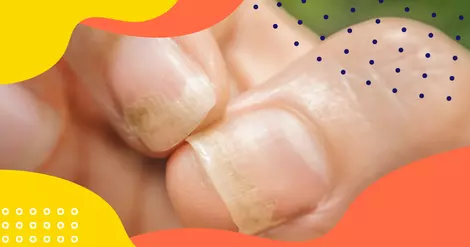
Nail psoriasis, or psoriatic nail disease, can cause discoloration, crumbling, and brittle nails. (CC BY-NC-ND 4.0/DermNet)
Psoriasis on the hands develops when the immune system becomes overactive, causing inflammation and the rapid buildup of skin cells. This leads to the thick, scaly patches often seen in palmoplantar psoriasis.
There’s some evidence that certain genes may increase the risk of developing psoriasis. Environmental and lifestyle factors — such as smoking, stress, skin injuries, and some medications — can also play a role in triggering or worsening symptoms.
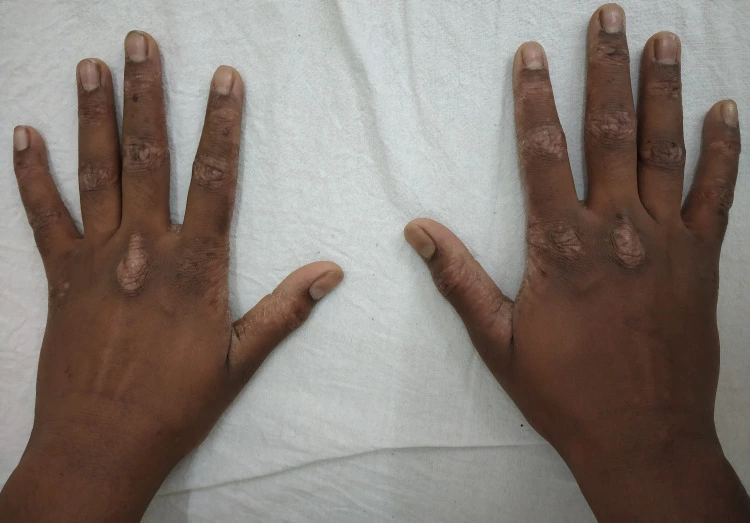
Psoriasis on the hands can cause thick, scaly plaques and changes in skin color, including lighter or darker patches, especially on the knuckles and fingers. (CC BY 4.0/Sekhar VP et al., Cureus, 2021)
The exact cause of pustular psoriasis, including palmoplantar pustulosis, is unknown. The small, pus-filled blisters often occur in people who currently smoke or used to smoke.
Other triggers may include:
Symptoms of hand psoriasis often include itchy, scaling, discolored skin patches that may appear on the palms and spread in a symmetrical pattern. Deep, painful fissures are also common.
“Mine started with an ungodly itch and later changed to small, red bumps and small dry spots. Now my hands look like I’ve been burned — red, peeling, painful, and itchy,” explained one member of MyPsoriasisTeam.
Hand psoriasis can look similar to other skin conditions, including eczema. That’s why it’s important to see a dermatologist to get an accurate diagnosis.
To make a diagnosis, a dermatologist may:
Members of MyPsoriasisTeam have shared how psoriasis on their hands affects their everyday lives. Many talk about unseen impacts, like social isolation, low self-esteem, and depression.

The condition can make home, work, and social situations more difficult:
Controlling hand psoriasis often requires a combination of general psoriasis treatments and targeted approaches for the skin on your hands.
Treatment options include:
A technique called occlusion can make your topical treatment more effective. It involves covering your hands with cotton or plastic gloves after applying the product, which can help the medicine absorb better. Talk with your healthcare provider before trying this technique.
Psoriasis can make the skin on your hands more vulnerable to irritation and injury. That’s why it’s important to care for your hands gently and consistently.
Using moisturizers, washing carefully, and avoiding friction or harsh chemicals can help protect your skin and reduce flare-ups.
Moisturizing is a key part of managing hand psoriasis. Apply moisturizers at least once a day, especially after a warm bath or shower. This can help soften rough patches, remove dead skin cells, and prevent your symptoms from getting worse.
Members of MyPsoriasisTeam often report good results with thick, hydrating creams and petroleum-based products like Vaseline. Lightweight lotions may not be rich enough, so look for products that are thicker and more emollient (soothing and softening).
“I put emollient on my hands, then Vaseline on top, to seal in moisture so they don’t split and crack. It seems to be working,” shared one member of MyPsoriasisTeam.
Another said, “I use Gold Bond Psoriasis Relief. I no longer scratch myself bloody, and I’m not ashamed to shake hands or let people see my hands.”
Washing your hands regularly is important for overall health and for helping you prevent the spread of viruses or bacteria. But for people with hand psoriasis, alcohol-based hand sanitizers may dry out the skin and trigger flare-ups.
Dermatologists recommend using gentle soap and water instead, as well as following up with moisturizer.
“I have pustular psoriasis on the palms of my hands and find that ‘normal’ alcohol hand sanitizers cause flare-ups,” said one member of MyPsoriasisTeam.
Choose fragrance-free cleansers that don’t contain harsh chemicals, and rinse thoroughly. Leftover soap can dry out the skin and lead to chapping or cracking.
On MyPsoriasisTeam, people share their experiences with psoriasis and psoriatic arthritis, get advice, and find support from others who understand.
Do you have hand psoriasis? Let others know in the comments below.
Get updates directly to your inbox.


Is there anything to help psoriasis on the face?

 Continue with Facebook
Continue with Email
Continue with Facebook
Continue with Email
Continue with Facebook
Continue with Email
Continue with Facebook
Continue with Email
Become a member to get even more





 Join
Join



 Your Privacy Choices

This is a member-feature!
Sign up for free to view article comments.
Yep, I have severe plantarpalmar (tops & bottoms of my feet & hands) psoriasis, severe plaque psoriasis, and I've have had bouts with erythrodermic psoriasis.
I just did some research and found that… read more
We'd love to hear from you! Please share your name and email to post and read comments.
You'll also get the latest articles directly to your inbox.